

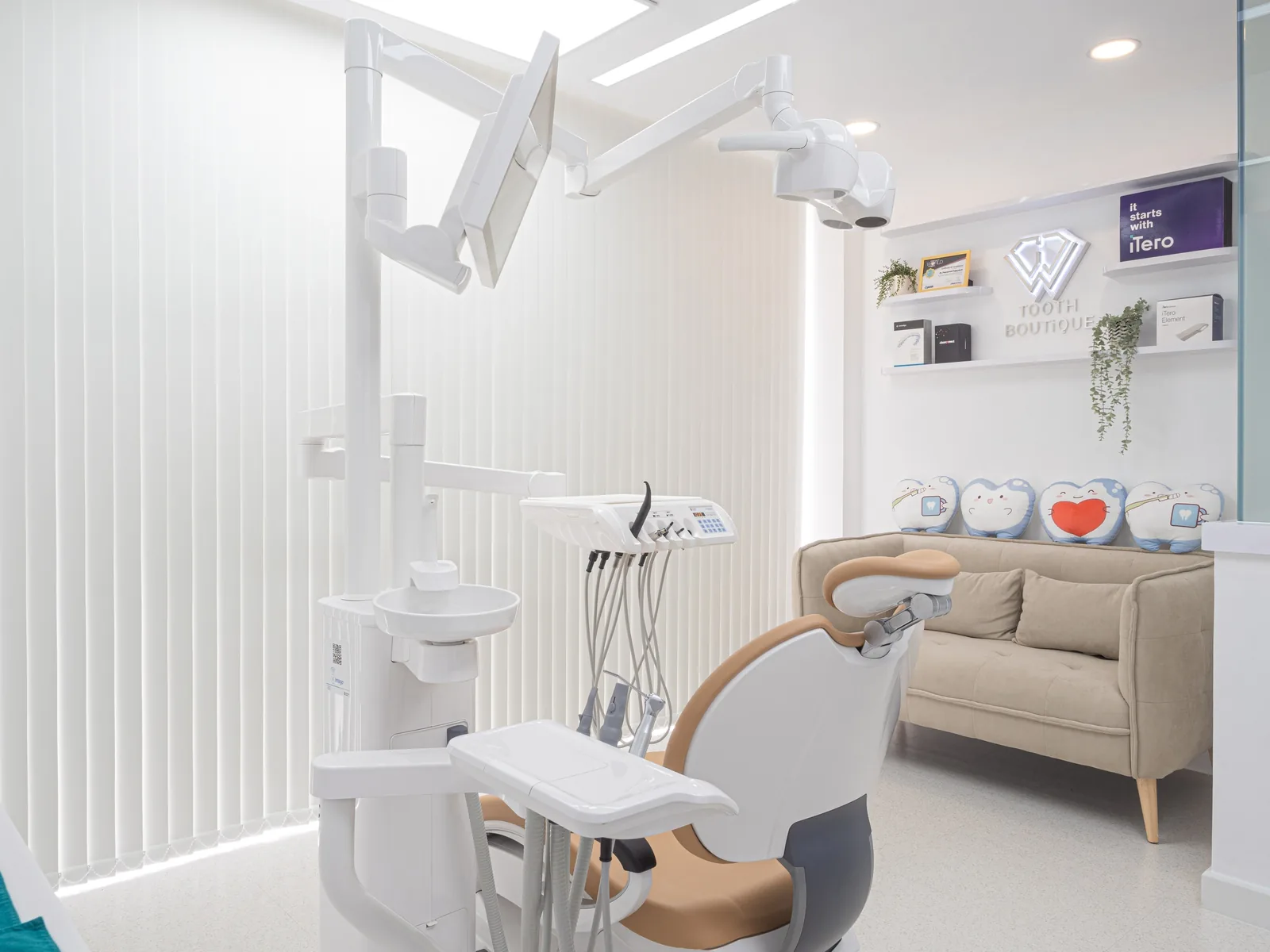
The question I hear most often from parents is "How old should my child be for a first dental visit?" Here is my answer, what a first visit looks like, how we prevent decay, and how to prepare.
When to come for the first time
When the first tooth appears, or at the latest by age one, whichever comes first.
Baby teeth can decay from the day they erupt, especially in children who fall asleep with a bottle or feed often at night. An early visit lets me check the teeth and gums and talk with you about brushing, milk and snacks before there is a problem, which is far easier and cheaper than treating one. And a first visit with no pain teaches a child the clinic is an ordinary place.
What a first visit looks like here
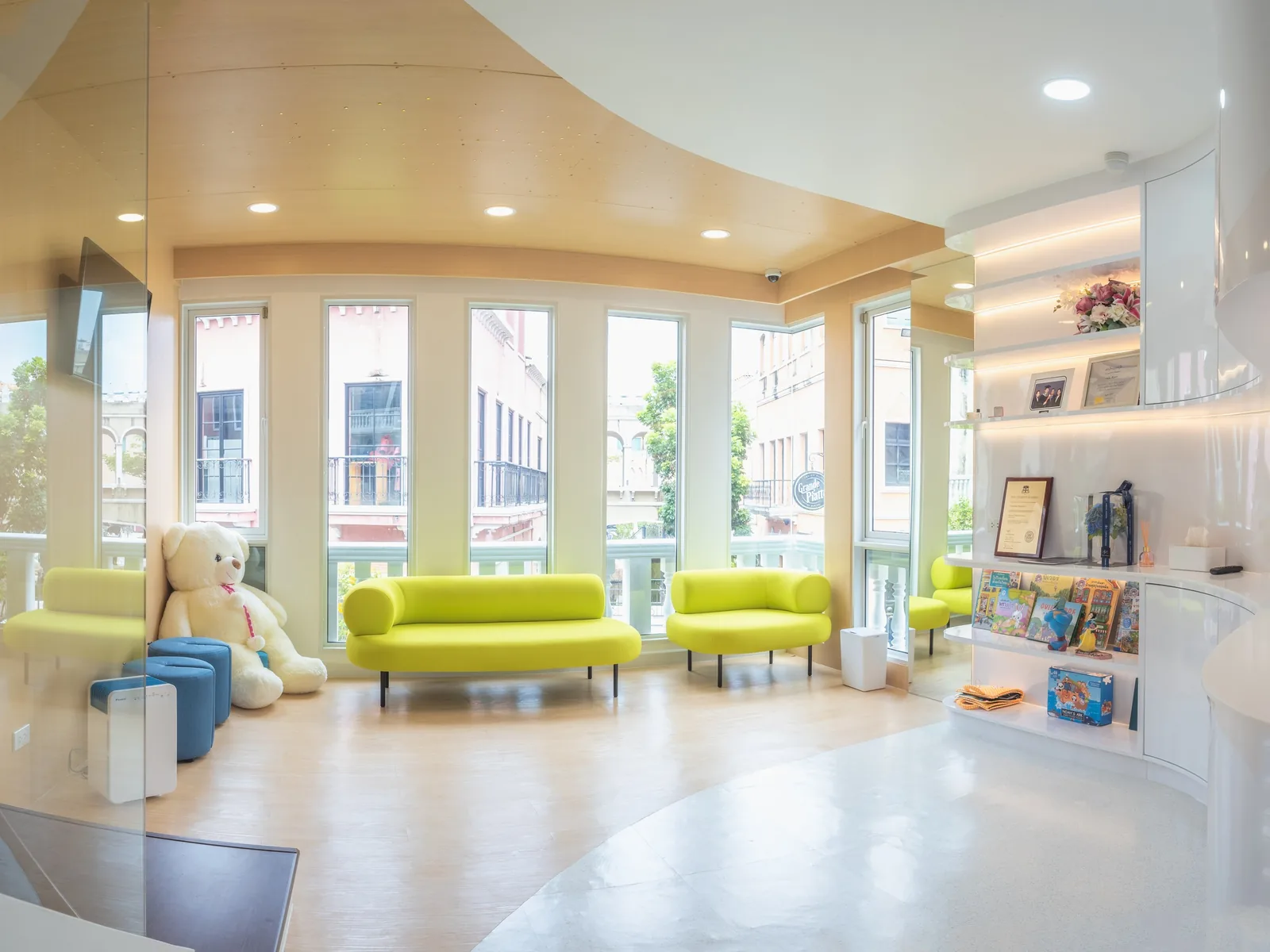
I see children at Tooth Boutique myself, from the first check-up until the last adult tooth is in.
For babies and toddlers I usually do not use the dental chair. The parent sits facing me, knees touching mine, and the child lies back with their head in my lap. They see their parent the whole time, and I see all I need in minutes.
Older children ride the chair up and down first and hold the small mirror. I say what I will do, show them, then do it. Nobody is held down and nothing is rushed. If all a child will allow is a count of their teeth, we count and book another visit. The first appointment is not about treatment. It is about your child going home thinking there was nothing to it.
I check that the teeth are coming through on time, look for early decay and check the gums, and ask about thumb-sucking or a pacifier, which can affect the bite later. Then I show you how to brush in a way that works at home.
Preventing decay
Brushing at home. Twice a day with a fluoride toothpaste, a small amount sized for your child's age. A parent should brush for the child, or at least go over it again, until the child can reach the back molars properly on their own.
Food and drink. What matters is how often the teeth meet sugar. A bedtime bottle, juice in a sippy cup or snacks grazed on all afternoon keep the teeth bathed in it for hours. Keep sweet things to mealtimes, follow them with water, and drop the bedtime bottle as early as you can.
Fluoride varnish. At each check-up I paint a fluoride varnish onto the teeth. It takes moments and does not hurt. I usually apply it about every six months, or more often for a child at higher risk of decay. See fluoride treatment.
Fissure sealants. The first adult molars come through at around six, behind the baby teeth, without any tooth falling out first, so many parents do not realize they are permanent. A sealant fills the deep grooves on their chewing surface, where a toothbrush cannot reach. No drilling, no injection, a few minutes per tooth, 900 baht per tooth (see the price list).
Children's scaling and polish. Older children with plaque and stain get a gentle scale and polish for 950 baht, plus 500 baht for fluoride varnish. See scaling and cleaning.
If a baby tooth is already decayed
"Does it need a filling if it is going to fall out anyway?" In most cases, yes. Some baby teeth stay until eleven or twelve. A deep cavity causes pain and can infect the adult tooth forming underneath. If the tooth is lost early, the neighbors drift into the gap and the adult tooth has nowhere to erupt, an orthodontic problem later.
Small and medium cavities I restore with a tooth-colored filling, at 900 to 2,500 baht per tooth depending on size and position. When a tooth is too broken down to save, or loose but not falling out, a baby-tooth extraction is the better choice, at 800 to 1,000 baht per tooth. These are starting prices; I confirm the exact fee after examining your child.
When to check the bite
As a specialist orthodontist, when I examine a child I am also watching how the jaws are growing, whether the front teeth protrude or cross over, and whether there is room for the adult teeth.
The right time for a proper look is around age seven, once the adult front teeth and first molars are through. A crossbite, prominent upper front teeth or a narrow jaw are much simpler to correct while the bones are still growing. For some children I recommend Invisalign First, clear aligners for a mix of baby and adult teeth. Many need nothing except a look every six months.
Preparing your child
- Book when your child is neither hungry nor tired, ideally mid-morning after breakfast.
- Play dentist at home. Count a teddy's teeth, then let the teddy count your child's.
- Treat the visit as an ordinary errand. Avoid "it won't hurt", because the word that sticks is "hurt".
- Never use the dentist as a threat.
- Bring a favorite toy or blanket.
- If you are nervous about dentists yourself, try not to show it. Children read faces.
Tears on the day are fine. Some children need two or three visits before they will open their mouth. I do not hurry them.
Book a visit
📲 Booking is easy
Message us on LINE or call 098 831 0246
🕙 Open daily 10:00–20:00 (closed Tuesdays)
The clinic is at Venice Di Iris, Vacharapol Road, Bang Khen
Tell us your child's age so I can set aside a suitable time.